The Wendy Project by Melissa Jane Osborne & Veronica Fish (Illustrations)
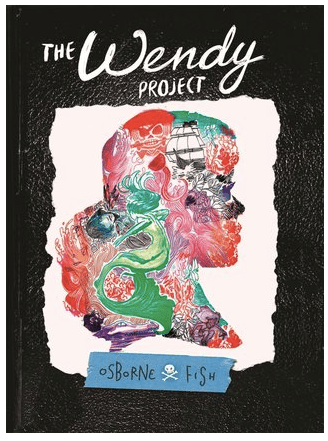
This graphic novel puts a unique and dark spin on the story of Peter Pan and Neverland. It tells the story of 16-year-old Wendy who’s little brother recently died in a car accident. To cope with his death, she imagines that he was taken to Neverland to live in a perpetual state of childhood with Peter Pan and the Lost Boys.
The Wendy Project, for being so short, packs quite a punch. Firstly, the artwork is stunning, with its vivid and strategically added pops of colors. Much of the story is displayed in black and white, so when splashes of color are added, they add significance to the story and highlight the distinction between the real world and the fairytale realm.
On the surface, the story is about a young girl who is caught between two worlds: reality and Neverland. But truly, it’s a story about dealing with grief for the first time and coming to terms with a devastating loss. The Wendy Project is heartbreaking, dreamlike, and creatively told, and it’s a perfect quick read for fans of fairytale retellings.
Luisa: Now and Then by Carole Maurel, adapted by Mariko Tamaki
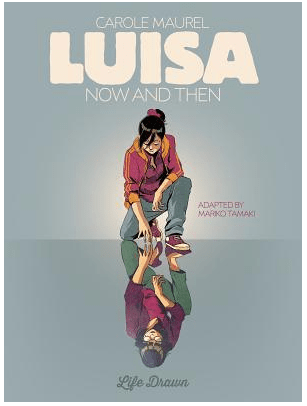
This graphic novel, adapted from French, tells the story of Luisa in the present day, where she encounters her 15-year-old self. The story details Luisa’s interactions with her younger self, who is unsure of how she was transported into the future. It also details her growing attraction to her female neighbor. Now, in her thirties, she confronts not only her sexuality, and acknowledges her dissatisfaction with her career.
Luisa: Now and Then is a light, breezy read, as it takes us on a tour of the character’s Parisian neighborhood. It’s also a humorous read, as Luisa constantly butts heads with her younger self and as the situation starts to take a turn into Freaky Friday territory and the characters begin to switch attributes. It’s also comical to see young Luisa with her nineties-style clothing and her nineties-style interests. And with the story’s lightness comes an important learning experience for Luisa, as she eventually begins to make her way toward self-acceptance.
Speak: The Graphic Novel by Laurie Halse Anderson & Emily Carroll (Illustrations)
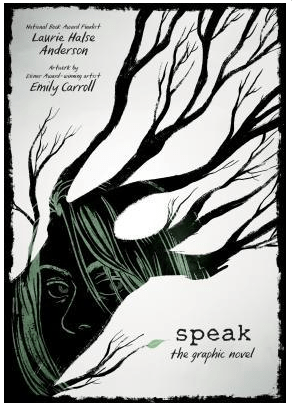
Laurie Halse Anderson’s 1997 novel, Speak, has worked its way to becoming a modern classic and a staple in high school assigned reading. Speak is a poignant story about a high school freshman named Melinda who’s been outcasted by her classmates and friends after calling the cops on a party. Melinda’s internal struggle is heartbreaking, as only we, the readers, know that Melinda called the cops after being raped by an upperclassman and one of the most popular boys in school.
This graphic novel adaptation tells the same story but in a different medium and through a visual lens. And just like the original novel, this version captures Melinda’s inner battle to accept that what happened to her was not her fault. And Emily Carroll’s haunting illustrations serve to complement Melinda’s dispirited and disheartened state of mind. Because Melinda does not speak, much of what she is experiencing comes through in her expressions, in her surroundings, and in her artwork – all of which are especially brought to life here, in the graphic novel. This is a must-read for anyone who read and was impacted by the original work.
 Pawsitive Reads